
































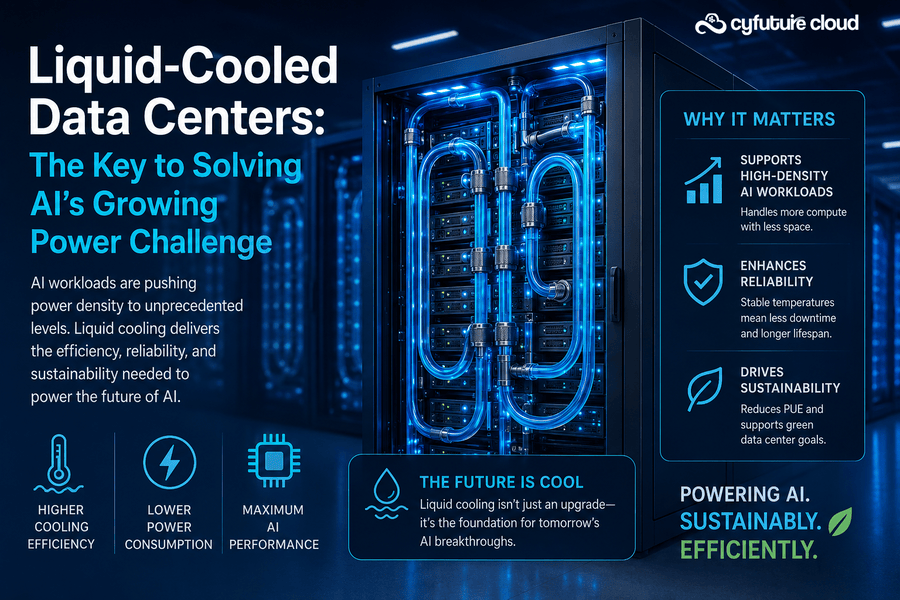
Artificial Intelligence (AI) is transforming industries worldwide, driving innovations in healthcare, finance, manufacturing, retail, and countless other sectors. Behind every AI model, however, lies a massive amount of computing power. Training and running advanced AI applications require thousands of high-performance GPUs and processors operating continuously. While these technologies unlock incredible capabilities, they also create a significant challenge: heat generation and power consumption.
Traditional air-cooled data centers are increasingly struggling to keep pace with the demands of modern AI workloads. As GPU densities rise and computational requirements grow, organizations need a more efficient and sustainable solution. This is where liquid-cooled data centers emerge as a game-changing technology.
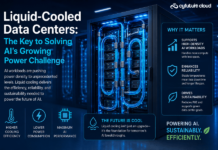
Liquid cooling is rapidly becoming the preferred infrastructure solution for AI-driven environments because it provides superior thermal management, improved energy efficiency, and higher computing density. As AI adoption accelerates globally, liquid-cooled data centers are proving to be the key to solving the industry’s growing power challenge.
Understanding the AI Power Problem
AI workloads are fundamentally different from traditional computing tasks. Modern AI models require extensive processing power, particularly during training phases. Large Language Models (LLMs), generative AI applications, machine learning algorithms, and deep learning systems rely heavily on GPU clusters.
A single high-performance AI server can consume several kilowatts of power. When hundreds or thousands of these servers operate together, the resulting energy demand becomes enormous. Along with power consumption comes a substantial increase in heat generation.
Some of the major challenges faced by AI data centers include:
- Increased power density per rack
- Excessive heat generation
- Higher cooling costs
- Limited scalability
- Increased carbon footprint
- Reduced hardware efficiency
Traditional cooling methods are no longer sufficient for handling these extreme thermal loads. As a result, data center operators are seeking advanced cooling technologies capable of supporting next-generation AI infrastructure.
What Are Liquid-Cooled Data Centers?
Liquid-cooled data centers use specialized liquids instead of air to remove heat from servers, GPUs, CPUs, and other computing components.
Because liquids can transfer heat significantly more effectively than air, they provide superior cooling performance while consuming less energy.
There are several types of liquid cooling technologies used in modern data centers:
Direct-to-Chip Cooling
In this method, cooling liquid flows through cold plates attached directly to heat-generating components such as CPUs and GPUs. The liquid absorbs heat and carries it away efficiently.
Immersion Cooling
Servers are submerged in a non-conductive dielectric fluid that directly absorbs heat from all components. This approach provides exceptional cooling performance for high-density computing environments.
Rear Door Heat Exchangers
These systems use liquid-cooled heat exchangers mounted at the rear of server racks to remove heat before it enters the data center environment.
Each method offers significant advantages over traditional air cooling and is increasingly being adopted for AI and high-performance computing applications.
Why AI Workloads Demand Liquid Cooling
AI servers generate far more heat than conventional enterprise workloads. High-performance GPUs can operate at power levels exceeding 700 watts per unit, with future generations expected to consume even more.
As rack densities continue to increase, air cooling reaches its physical limitations. Moving enough air to cool modern AI clusters becomes expensive, inefficient, and impractical.
Liquid cooling addresses these issues by:
- Removing heat more effectively
- Supporting higher rack densities
- Reducing energy consumption
- Improving hardware performance
- Enabling larger AI deployments
Without advanced cooling technologies, many organizations would struggle to scale their AI initiatives efficiently.
Benefits of Liquid-Cooled Data Centers
1. Superior Thermal Management
One of the biggest advantages of liquid cooling is its exceptional ability to manage heat.
Water and specialized cooling liquids can transfer heat thousands of times more efficiently than air. This allows data centers to maintain optimal operating temperatures even during intensive AI workloads.
Effective thermal management helps prevent:
- Hardware overheating
- Performance degradation
- Unexpected downtime
- Component failures
As a result, AI systems can operate at peak performance for longer periods.
2. Improved Energy Efficiency
Cooling systems account for a significant portion of data center energy consumption.
Traditional air cooling requires large numbers of fans, air conditioners, and cooling units. These systems consume substantial amounts of electricity.
Liquid cooling dramatically reduces cooling-related energy requirements by:
- Minimizing fan usage
- Lowering HVAC dependency
- Increasing cooling efficiency
- Reducing Power Usage Effectiveness (PUE)
Many liquid-cooled facilities achieve significantly better energy efficiency compared to traditional data centers.
3. Higher Rack Density
AI infrastructure demands increasingly dense computing environments.
Air-cooled facilities often struggle when rack power densities exceed 20–30 kW. In contrast, liquid-cooled systems can comfortably support densities exceeding 100 kW per rack and, in some cases, much higher.
Higher density enables organizations to:
- Maximize data center space
- Deploy more GPUs
- Increase computing capacity
- Reduce infrastructure expansion costs
This makes liquid cooling particularly attractive for AI and High-Performance Computing (HPC) environments.
4. Reduced Operating Costs
Although liquid cooling may require higher initial investment, it often delivers substantial long-term cost savings.
Organizations benefit from:
- Lower energy bills
- Reduced cooling expenses
- Improved hardware lifespan
- Fewer maintenance requirements
Over time, these savings can significantly improve overall data center economics.
5. Enhanced Sustainability
Sustainability has become a critical priority for enterprises and data center operators.
AI workloads consume enormous amounts of electricity, making environmental impact a growing concern.
Liquid cooling contributes to sustainability by:
- Reducing energy consumption
- Lowering greenhouse gas emissions
- Improving resource efficiency
- Supporting green data center initiatives
Many organizations view liquid cooling as an essential component of their ESG (Environmental, Social, and Governance) strategies.
The Role of Liquid Cooling in GPU-Intensive AI Applications
Modern AI applications depend heavily on GPU acceleration.
Examples include:
- Large Language Models (LLMs)
- Generative AI platforms
- Computer vision systems
- Autonomous vehicles
- Natural Language Processing (NLP)
- Scientific simulations
- Predictive analytics
These workloads require enormous computational resources and generate significant thermal output.
Liquid cooling allows organizations to deploy larger GPU clusters while maintaining stable operating conditions. By efficiently removing heat directly from processors, liquid-cooled systems enable GPUs to run at higher utilization levels without thermal throttling.
This directly improves AI performance and productivity.
Supporting the Future of AI Infrastructure
Industry experts predict that AI adoption will continue growing exponentially over the next decade.
As model complexity increases, future AI systems will require:
- More GPUs
- Greater processing power
- Higher memory capacity
- Increased power density
Traditional air-cooled infrastructure simply cannot support these future requirements at scale.
Liquid-cooled data centers provide a future-ready foundation by enabling:
- Scalable AI deployments
- Advanced GPU clusters
- High-density computing environments
- Sustainable infrastructure growth
Organizations investing in AI today must consider how their infrastructure will support tomorrow’s demands.
Challenges and Considerations
While liquid cooling offers substantial advantages, implementation requires careful planning.
Key considerations include:
Infrastructure Investment
Deploying liquid cooling often requires specialized equipment and facility modifications.
Technical Expertise
Managing liquid-cooled environments requires trained personnel familiar with advanced cooling technologies.
System Integration
Organizations must ensure compatibility between cooling infrastructure and server hardware.
Maintenance Requirements
Although maintenance can be reduced overall, liquid cooling systems still require regular monitoring and servicing.
Despite these considerations, the long-term benefits often outweigh the initial challenges, particularly for AI-focused operations.
Industry Adoption Is Accelerating
Leading technology companies, cloud providers, and AI research organizations are rapidly adopting liquid cooling solutions.
The rise of AI has transformed liquid cooling from a niche technology into a mainstream requirement.
Industries embracing liquid-cooled data centers include:
- Cloud computing providers
- AI startups
- Research institutions
- Financial services
- Healthcare organizations
- Government agencies
- Manufacturing enterprises
As AI becomes more integrated into business operations, demand for liquid-cooled infrastructure is expected to increase significantly.
Conclusion
Artificial Intelligence is reshaping the digital world, but its rapid growth brings unprecedented power and cooling challenges. Traditional air-cooled data centers are reaching their operational limits as GPU densities and computational demands continue to rise.
Liquid-cooled data centers offer a powerful solution by delivering superior thermal management, enhanced energy efficiency, higher rack densities, and improved sustainability. They enable organizations to support demanding AI workloads while reducing operational costs and environmental impact.
As AI continues to evolve, liquid cooling will play a critical role in building the next generation of data center infrastructure. Organizations seeking to unlock the full potential of AI must invest in technologies capable of meeting future performance and power requirements.
The future of AI is powerful, data-intensive, and increasingly dependent on advanced cooling solutions. Liquid-cooled data centers are not just an innovation—they are becoming an essential foundation for the AI-driven world.