































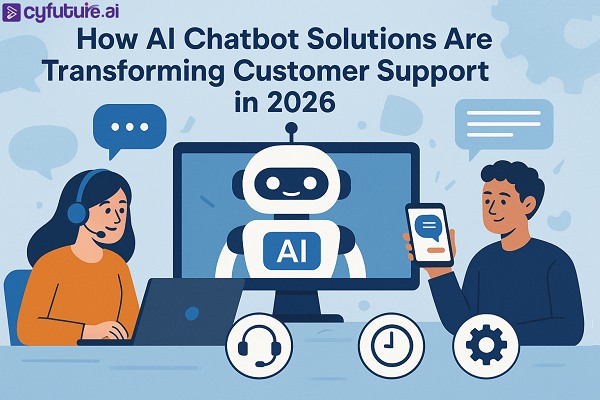
Customer support has changed more in the past three years than in the previous two decades, and AI chatbot solutions sit right at the center of this transformation. In 2026, businesses of all sizes—from startups to global enterprises—are using AI-driven support systems to deliver faster, smarter, and more personalized customer service. What used to be seen as a futuristic add-on has now become a core business necessity.
Below is a 900-word blog breaking down exactly how AI chatbots are reshaping customer service this year and why companies that embrace them are staying far ahead of the competition.
The Rise of Intelligent Automation in Customer Support
The early versions of chatbots were limited, often frustrating, and only capable of answering a small set of scripted questions. But in 2026, AI chatbots have evolved into intelligent, conversational systems powered by real-time data, advanced natural language understanding, and continuous learning capabilities. These bots can handle everything from simple FAQs to complex troubleshooting and billing inquiries—without a human agent stepping in.
Businesses are taking notice. According to industry trends, over 80% of companies now use some form of AI-driven customer support, and the number is still rising. The big shift is no longer whether companies should implement chatbots, but how deeply they integrate them across every customer touchpoint.
24/7 Availability: A New Standard for Customer Experience
Consumers today expect instant answers—day, night, weekends, and holidays. AI chatbots make this possible consistently, without stretching staffing budgets or overwhelming teams.
In 2026, customers view 24/7 availability as a basic expectation rather than a premium service. AI chatbots meet this need effortlessly by:
- Responding instantly to inquiries
- Handling high volumes of requests simultaneously
- Eliminating long wait times
- Providing reliable support even during peak seasons
This always-on accessibility greatly improves customer satisfaction and brand trust. When customers feel heard at any hour, they are far more likely to stay loyal.
Hyper-Personalized Interactions at Scale
One of the biggest breakthroughs in 2026 is personalization. Chatbots aren’t just answering questions—they’re tailoring conversations based on user history, purchase behavior, preferences, and even sentiment.
Powered by advanced analytics, AI chatbots can now:
- Recommend products based on past purchases
- Recognize repeat customers and greet them personally
- Detect frustration in tone and escalate to a human when needed
- Offer tailored solutions instead of generic replies
This level of personalization used to require a team of well-trained agents. Now it’s delivered automatically, consistently, and at scale.
Seamless Human-Bot Collaboration
Despite major advancements, AI chatbots are not replacing human agents. Instead, they are acting as powerful collaborators. In 2026, customer support is increasingly hybrid: chatbots handle repetitive tasks while human agents focus on high-value and emotionally sensitive interactions.
AI chatbots assist support teams by:
- Pre-collecting customer information
- Understanding issue context
- Suggesting response templates
- Routing inquiries to the right agent
- Summarizing conversations for quick reference
This boosts agent productivity, reduces burnout, and creates a smoother, faster experience for customers. When a chatbot hands off a conversation, the human agent steps in fully informed and ready to help.
Voice-Enabled Support: The Next Big Leap
Voice AI is one of the fastest-growing segments of customer service in 2026. Voice-enabled chatbots allow users to speak naturally—as if talking to a human—while the system instantly interprets intent and provides solutions.
Companies are adopting voice-based support for:
- Customer helplines
- In-app voice assistants
- Self-service kiosks
- Smart devices
This shift makes customer support more accessible, especially for users who prefer speaking over typing. With improved accuracy and faster response times, voice AI is breaking down communication barriers and making support more inclusive.
AI-Driven Analytics for Better Decision-Making
Every customer interaction provides valuable insights. AI chatbots are now capable of analyzing millions of these interactions to identify trends, product issues, service gaps, and customer pain points.
In 2026, AI-powered analytics allow businesses to:
- Predict customer needs
- Track sentiment in real time
- Identify frequently asked questions
- Spot emerging problems before they escalate
- Improve product design based on feedback patterns
This transforms support from a reactive function to a proactive, data-driven strategy that fuels continuous improvement.
Reducing Costs Without Sacrificing Quality
One of the most compelling reasons companies are adopting AI chatbot solutions is cost efficiency. Maintaining a large support team round-the-clock is expensive, especially when handling huge volumes of repetitive inquiries.
Chatbots significantly reduce operational costs by:
- Automating repetitive tasks
- Increasing agent efficiency
- Reducing the need for large support teams
- Minimizing resolution times
Studies in 2026 show businesses can reduce customer support costs by up to 40% with AI-based automation—while simultaneously improving customer satisfaction scores.
Enhanced Security and Compliance
AI chatbots in 2026 come with built-in advanced security protocols that protect user data and comply with global regulations like GDPR, CCPA, and emerging AI governance standards. Modern systems use encrypted communication, identity verification, and fraud detection to ensure safe interactions.
This is especially crucial for industries such as:
- Banking
- Healthcare
- Insurance
- E-commerce
Users can now trust chatbot interactions with sensitive information, knowing their data is protected by robust security measures.
The Future of AI Chatbots: What Comes Next?
As we move deeper into 2026, AI chatbots will continue evolving toward even more natural conversations, emotional intelligence, predictive capabilities, and autonomous problem-solving.
We can expect future chatbots to:
- Understand emotions with higher accuracy
- Sync seamlessly across all devices
- Offer multilingual support with human-like fluency
- Act as proactive assistants instead of reactive tools
The ultimate goal? A frictionless, fully connected support ecosystem where customers get the help they need before they even ask for it.
Conclusion
AI chatbot solutions are no longer just technological innovations—they’re essential tools that are transforming customer support in 2026. They bring speed, personalization, cost efficiency, and intelligence to the forefront of customer interactions. Companies adopting these advanced solutions are improving their customer experience dramatically while increasing productivity and reducing operational costs.